
Automation is one of the most powerful tools available to businesses today. Yet many business owners still view it primarily as a cost-cutting measure. They see automation as something that replaces people, reduces headcount, and saves money. This is a limited and ultimately unhelpful perspective.
The real value of automation is not cost reduction. It is transformation. Automation changes how your business operates, how your team works, and how your clients experience your services. It enables growth that would otherwise be impossible. It creates capacity that did not previously exist.
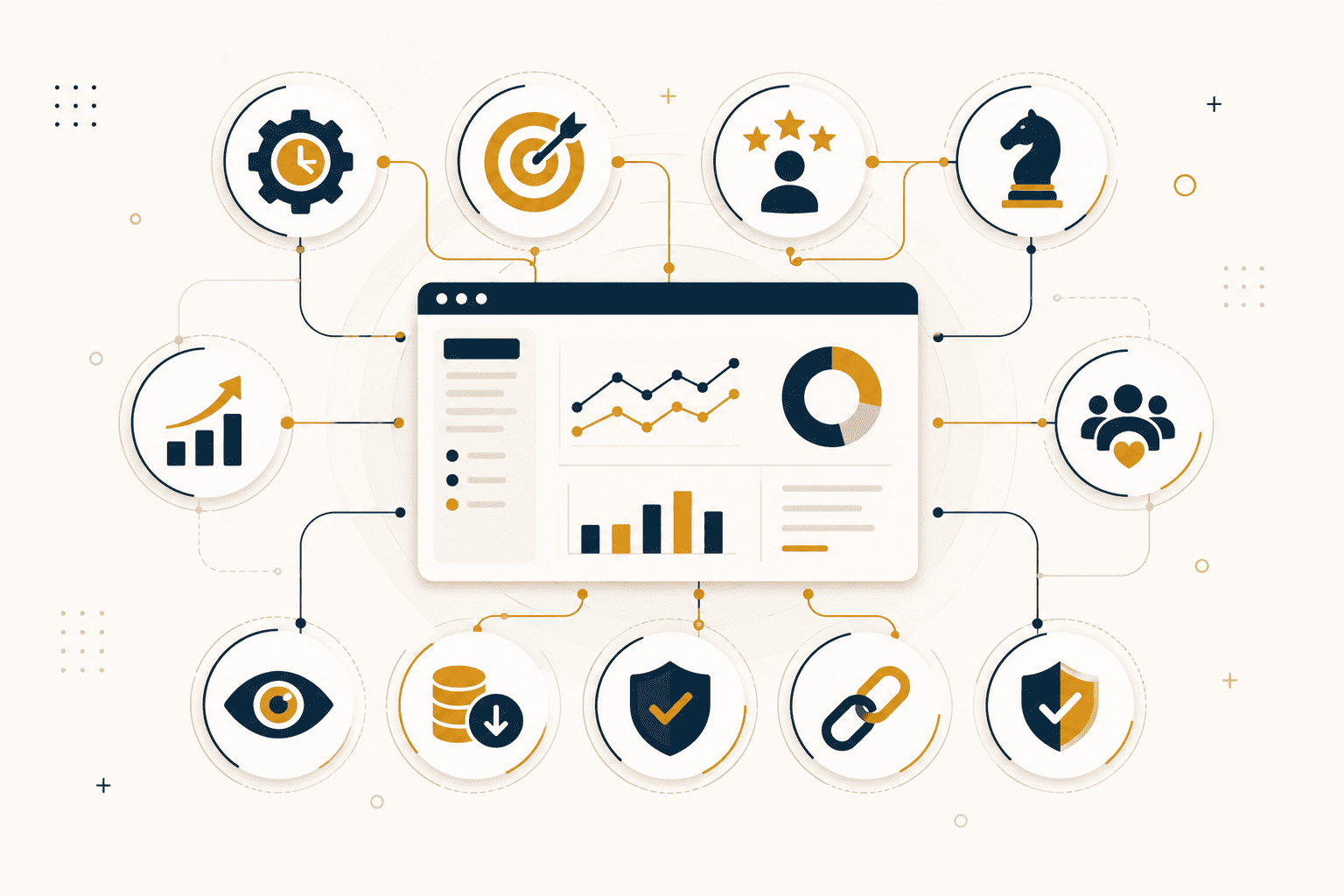
This guide walks through the ten most significant benefits of automating your business operations. These benefits apply regardless of your industry, your location, or the size of your business.
1. Increased Efficiency
The most obvious benefit of automation is increased efficiency. Automation handles repetitive tasks continuously and reliably, allowing your team to focus on work that requires human judgement and creativity.
Consider a task that takes a team member thirty minutes each day. Over a year, that is more than a hundred hours — the equivalent of more than two full working weeks. Automation can often handle that same task in seconds, with no ongoing time cost.
The cumulative effect of automating multiple tasks is significant. Your team is not working longer hours. They are working on more valuable work.
2. Enhanced Accuracy
Human error is inevitable. It is not a reflection of your team's capability. It is a reflection of the fact that humans are not designed to perform repetitive, detailed tasks consistently without error.
Manual data entry has a well-documented error rate. These errors compound. An error in an invoice leads to a payment discrepancy. An error in an order leads to a delivery problem. An error in a record leads to a compliance issue.
Automation eliminates these errors. The system does exactly what it is programmed to do, every time. The improvement in accuracy directly affects profitability, compliance, and client trust.
3. Better Customer Experience
Clients expect fast, reliable service. They do not care about your internal processes. They care about whether you respond quickly, whether your delivery is consistent, and whether their experience of your business is positive.
Automation enables faster response times. An automated welcome message acknowledges a client's enquiry immediately. An automated order confirmation provides certainty. An automated follow-up ensures that no client falls through the cracks.
The consistency that automation provides also builds trust. When clients know what to expect from you — and when you deliver that consistently — they develop confidence in your business.
4. Competitive Advantage
Businesses that run on efficient automated processes can offer better pricing, faster delivery, and more consistent quality than competitors who rely on manual workflows.
This advantage is not temporary. Once you have built effective automation into your operations, it continues to work for you indefinitely. Your competitors cannot easily replicate it without making similar investments.
In a competitive market, the businesses with the most efficient operations win. Automation is the most reliable path to operational efficiency.
5. Scalability
Manual processes have a hard limit. At a certain volume, they cannot absorb additional load. Adding more people is the only option, and that option is expensive and often ineffective.
Automation removes this limit. A properly automated order management process handles ten orders and ten thousand orders with exactly the same effort. The system scales with your business.
This scalability is what enables sustainable growth. Without it, growth eventually becomes a problem rather than a benefit.
6. Improved Employee Satisfaction
Repetitive, low-value work is demotivating. Your team members did not join your business to spend their days entering data or sending routine emails. They joined to contribute to something meaningful.
Automation removes this demotivating work. Your team can focus on the work that actually requires their skills and judgement. They are more engaged, more productive, and more satisfied.
The businesses that retain the best talent are often those that give their people work worth doing. Automation is a key part of that.
7. Better Visibility
When processes are manual, you have limited visibility into what is actually happening. Orders can be lost. Tasks can fall through the cracks. Problems can go undetected until they become serious.
Automation gives you visibility. You can see what is happening in real time. You can track progress. You can identify problems before they become crises. The visibility that automation provides is the foundation of effective management.
8. Cost Reduction
While cost reduction is not the primary benefit of automation, it is a real and significant benefit. Automation reduces the time required to complete tasks. It reduces the cost of errors. It reduces the need for additional headcount as your business grows.
These cost savings are not about replacing people. They are about ensuring that the people you employ are spending their time on work that justifies their salary.
9. Consistency
Manual processes are inconsistent. Different people do things differently. The same person does things differently on different days. This inconsistency affects quality, delivery, and client experience.
Automation ensures consistency. The system does the same thing every time. The quality of output is consistent regardless of who is working or when the work is being done.
This consistency builds trust and reduces variability in your operations.
10. Business Resilience
Businesses that rely on manual processes are vulnerable. When a key person leaves, their knowledge and capability leave with them. When a key person is unavailable, the process stops.
Automation makes your business more resilient. The system continues to work regardless of who is available. Your business is less dependent on any single person.
This resilience is valuable in normal times. It becomes critical when things go wrong.
Getting Started
The benefits of automation are significant. The question is not whether to automate but where to start. The most effective approach is to identify one high-impact, repetitive process, automate it well, measure the results, and then expand.
The tools to start are accessible. No-code and low-code platforms make it possible to automate many processes without custom development. The investment required is modest compared to the return.
The businesses that approach automation strategically — identifying the highest-impact processes first, building properly, and measuring results — tend to see significant improvements in efficiency, accuracy, and scalability.
Every business is different. What works for one may not work for another. If you would like to discuss whether automation could work for your specific situation, we are always available for a conversation.

Leave a Comment