
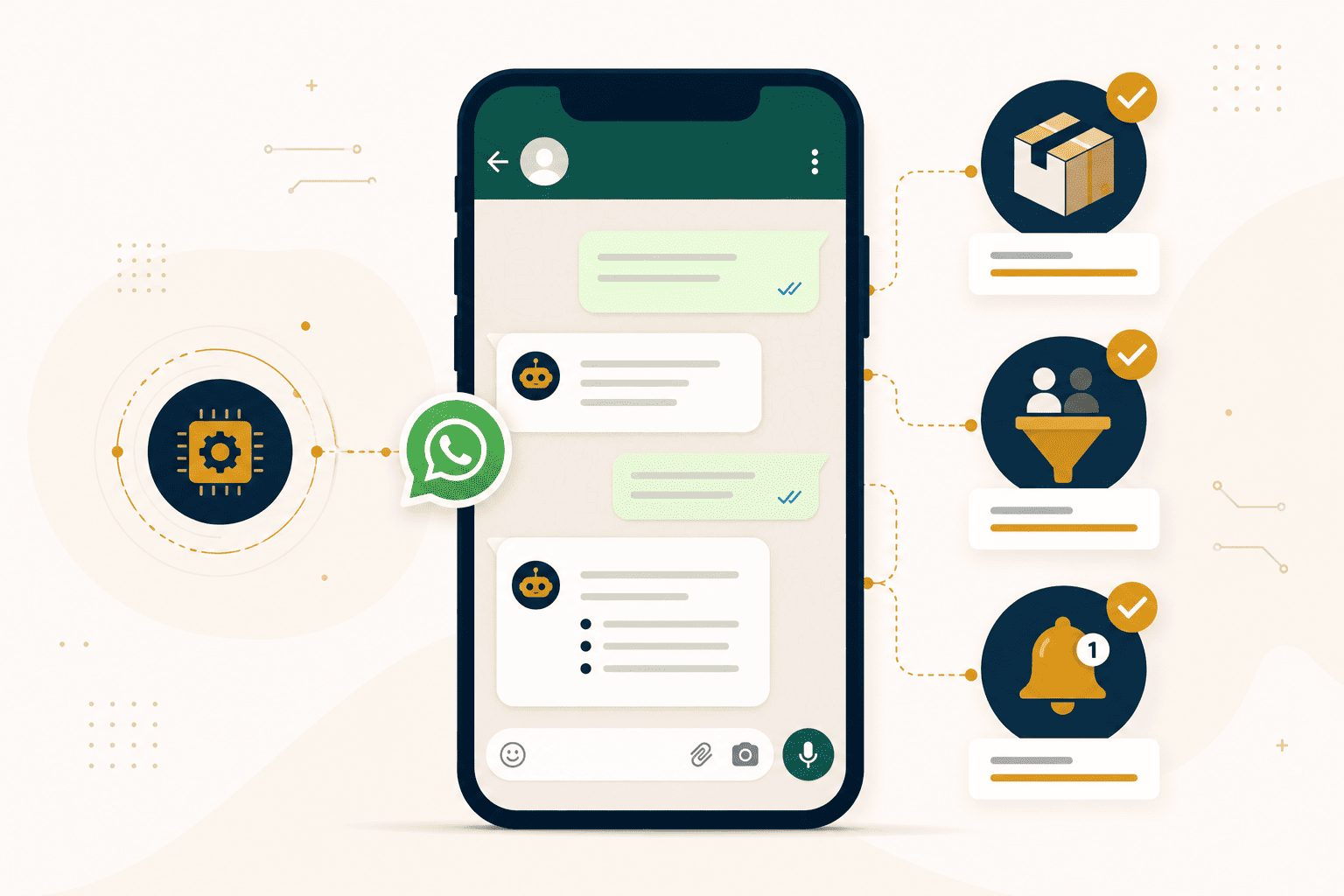
WhatsApp has become the primary communication channel for many businesses in Nigeria and across Africa. It is fast, familiar, and widely used. For many businesses, it is where enquiries come in, orders are placed, and customer relationships are built. But using WhatsApp as a business tool without automation creates a significant problem.
When your team is manually responding to every message, tracking every order, and following up with every lead through chat threads, you are operating at a scale ceiling. The business cannot grow beyond the capacity of your team to manage conversations. And when your team is unavailable — after hours, on weekends, or during busy periods — opportunities are missed and customers are left waiting.
The solution is not to abandon WhatsApp. The solution is to use it strategically, with automation handling the repetitive, predictable parts of customer engagement so your team can focus on the conversations that genuinely require human attention.
The Problem with Manual WhatsApp Management
Most businesses using WhatsApp for customer engagement are running on a reactive model. Someone sends a message. A team member reads it, responds, and takes whatever action is needed. This works when the volume is low. It stops working when the volume grows.
The cracks start to show in several ways. Messages are missed because they get buried in chat threads. Customers receive inconsistent responses because different team members handle things differently. Orders get lost because the information is scattered across conversations rather than recorded in a structured system. Follow-ups fail because there is no reliable system to track who has been contacted and who has not.
The result is a business that is constantly reacting rather than proactively managing. The team is busy, but the busyness is not translating into better service or more sales. It is translating into stress and missed opportunities.
This is where automation changes the equation.
Key WhatsApp Automation Features
Automating your WhatsApp business is not about replacing human interaction. It is about ensuring that the human interactions happen when they matter most, while routine tasks are handled reliably and consistently by a system.
Automated Welcome Messages
When a customer messages you for the first time, the immediate response sets the tone for the entire relationship. A slow or absent response signals that your business is not responsive. A warm, professional response signals that you value their enquiry.
Automated welcome messages ensure that every new contact receives an immediate reply. The message can include your business hours, a brief overview of what you offer, and guidance on what to do next. This is not about closing a sale instantly. It is about acknowledging the customer, managing their expectations, and giving them a clear path forward.
The best part is that this happens automatically, regardless of the time of day. A customer who messages at 9 PM on a Sunday receives the same professional welcome as one who messages during business hours.
Order Management Integration
This is where automation moves from simple messaging to operational transformation. When your WhatsApp is connected to your inventory or order management system, you can automatically send order confirmations, shipping updates, and receipts without any manual effort.
The workflow looks like this: a customer places an order through WhatsApp. The automation captures the order details, updates your inventory, sends a confirmation to the customer, and triggers a notification to your fulfilment team — all without anyone manually typing or forwarding information.
The customer receives a professional, consistent experience. Your team receives clear, structured information they can act on. And you have a record of every transaction, eliminating the chaos of orders scattered across chat threads.
Lead Qualification
Not every enquiry is the same. Some are ready to buy. Some are just browsing. Some require significant education before they are ready to make a decision. Manually figuring out which is which takes time and often leads to mismatched effort.
Automated lead qualification uses a series of questions to understand where the prospect is in their journey. The responses determine what happens next. A prospect who is ready to buy is routed to a sales conversation. A prospect who needs more information is sent relevant resources. A prospect who is not a good fit is politely redirected.
This saves your team hours of manual screening and ensures that your limited human attention is focused on the prospects most likely to convert.
Getting Started with WhatsApp Automation
The first step is identifying which parts of your WhatsApp workflow are most repetitive and predictable. The welcome message is an obvious starting point because it is simple and high-impact. Order management is a natural next step because the benefits are significant and measurable.
The tools to implement WhatsApp automation are accessible. Many of the popular no-code automation platforms, including Make.com and Zapier, integrate directly with WhatsApp Business API. This means you can set up most automation flows without needing custom development.
The investment is time to set it up once. After that, your automated flows run indefinitely, handling the routine work so your team does not have to.
What Automation Cannot Do
WhatsApp automation handles the predictable and the structured. It does not handle complex customer issues, negotiation, or relationship building. When a customer has an unusual complaint or a specific question that falls outside the standard flow, a human needs to step in.
The goal is to ensure that humans are spending their time on these high-value conversations rather than on tasks a system could handle.
The Future of Customer Engagement
The businesses that are best positioned for growth are those that use automation strategically. They are not replacing human interaction. They are ensuring that human interaction happens where it matters most, while routine tasks are handled consistently and efficiently by systems.
WhatsApp automation is a practical, accessible starting point for this journey. The tools are available. The benefits are measurable. And the investment required is modest compared to the return.
Every business is different. What works for one may not work for another. If you would like to discuss whether WhatsApp automation could work for your specific situation, we are always available for a conversation.

Leave a Comment