
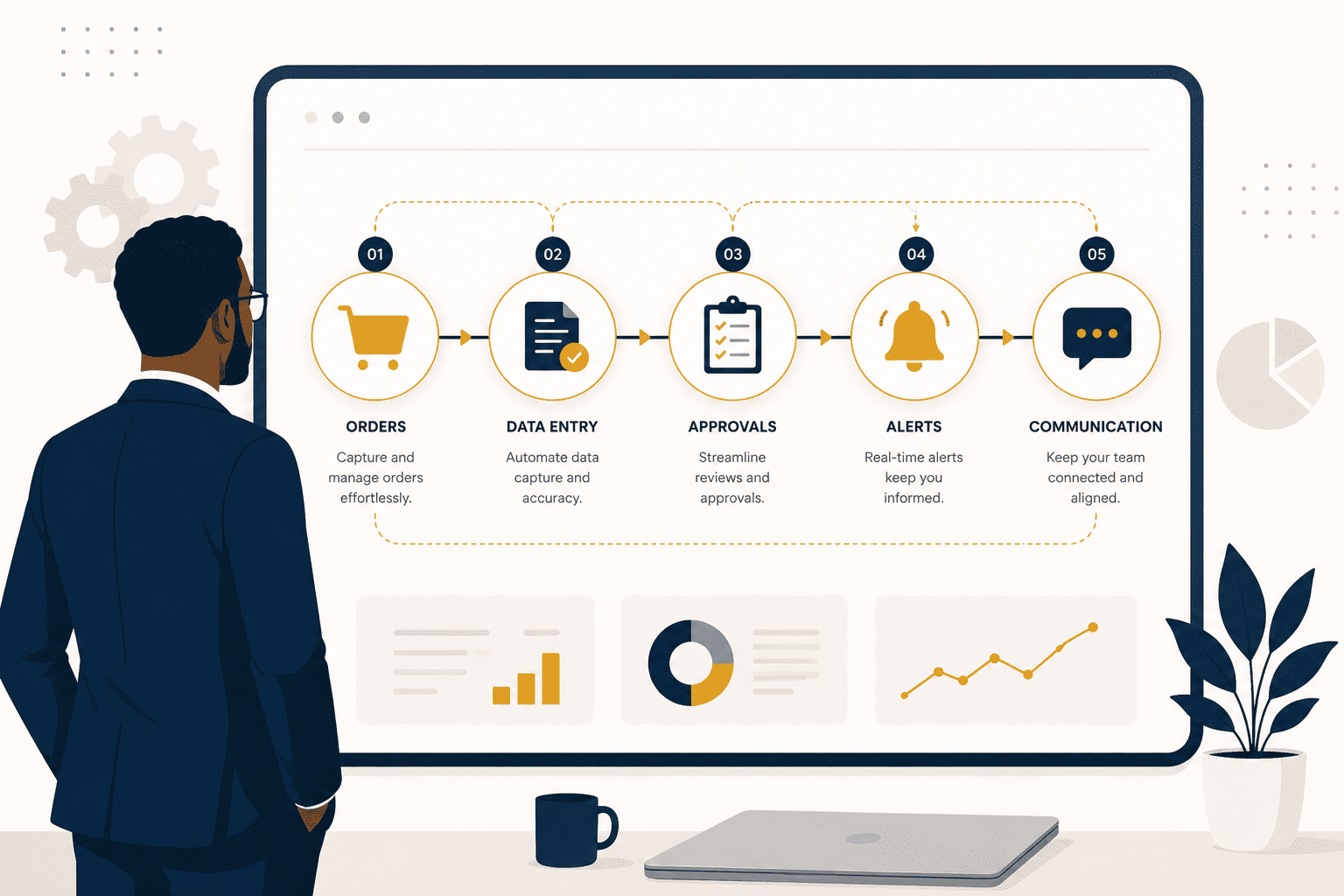
Automation is not just for large corporations. In fact, the businesses that benefit most from automation are often small and mid-sized enterprises that are struggling to keep up with growth. When your business is growing, it is easy to focus entirely on acquiring new customers and delivering on promises. But if your internal operations are still running the way they did when you started, growth will eventually become a problem rather than a blessing.
The challenge is that operational inefficiency tends to creep in slowly. What worked when you had five customers a week does not work when you have fifty. What was manageable when you had one or two staff members becomes chaotic when you have a team. The warning signs are usually visible long before things break completely, but they are easy to dismiss as temporary growing pains.
This guide walks through five clear signs that your business has reached the point where automation is not just an option — it is a requirement for sustainable growth.
Sign 1: You Are the Bottleneck
If every decision, every order approval, and every client sign-off has to go through you personally, your business has a scaling problem that no amount of hard work will fix. This is one of the most common patterns in growing businesses. The founder is the sole person who can approve a proposal, release a payment, or resolve a client issue. Everyone else waits for you, and while they wait, work stalls.
The impact of this is significant. Clients experience delays. Team members become frustrated because they cannot move forward without you. And you personally are stretched thin, spending your time on routine approvals that could easily be handled by a system or delegated with proper guardrails.
Automation is the solution. Workflows can be designed to handle standard approvals automatically based on predefined rules. For example, an invoice under a certain amount can be approved and paid without manual intervention. A client proposal that meets standard criteria can be sent without requiring your personal sign-off. For the exceptions that genuinely need your input, automated notifications can bring only those edge cases to your attention.
The goal is not to remove yourself from the business entirely. It is to ensure that your time and attention are reserved for the decisions that truly require your judgement, while routine matters are handled consistently and efficiently.
Sign 2: Orders and Enquiries Live in WhatsApp
WhatsApp is an excellent communication tool. It is fast, familiar, and widely used across Nigeria and internationally. But it was never designed to be an order management system. When your order history, client enquiries, and delivery confirmations are scattered across individual chat threads, you have a serious visibility problem.
Consider what happens when an order is placed via WhatsApp. The details sit in a chat message, which may be seen by one person. If that person is unavailable, the order can easily be missed. If there is a dispute or a question later, finding the original conversation is time-consuming and unreliable. If you need to analyse sales trends, there is no centralised record to work from.
Automation solves this by moving order capture and enquiry management into structured systems. A simple automated form can capture all the necessary information, store it in a central database, and trigger appropriate actions — a confirmation to the customer, a notification to your fulfilment team, and a record for your own reporting. Clients still reach out through WhatsApp if they prefer, but that initial contact triggers an automated process that moves the information into your operational systems.
This is not about replacing WhatsApp. It is about ensuring that WhatsApp conversations feed into a system that gives you visibility, control, and consistency.
Sign 3: Data Is Typed More Than Once
This is one of the clearest indicators of an automatable process. If a piece of information — a client's name, an order number, a delivery address — is being manually typed into multiple places, your team is doing unnecessary work that carries a high risk of error.
The typical pattern looks something like this: an order comes in, someone writes it down in a notebook or a WhatsApp note. Later, they enter it into a spreadsheet. When it is time to invoice, they type the same details again into an invoicing system. If there is a delivery to coordinate, the address is typed again into a dispatch note or a logistics platform.
Each time that information is manually entered, there is a chance of a mistake. A digit miskeyed in a phone number, a letter dropped from an address, a decimal point misplaced in a price. These small errors add up to high costs in time, customer frustration, and lost revenue.
Automation eliminates the repeated typing. The information is entered once — ideally by the customer themselves through a form — and then flows automatically to every system that needs it. The order system updates the inventory. The invoicing system generates the invoice. The logistics system creates the delivery record. All without anyone retyping a single piece of information.
Sign 4: You Find Out About Problems Too Late
If you are learning about a delivery failure, a missed deadline, or a client complaint from the client themselves rather than from your own systems, you have a visibility gap that automation can close.
When problems are identified late, the damage is often already done. The client is already frustrated. The opportunity to correct the issue before it impacted the client has passed. And you are left reacting rather than preventing.
Automated monitoring and alerting systems change this dynamic. When an order is delayed, an automated system can flag it immediately. When a task misses its deadline, an alert can be sent to the responsible team member. When a client reaches a certain number of days without follow-up, a reminder can be triggered.
The goal is to give you visibility into your operations in real time, not after the fact. When issues are identified early, they can be resolved before they become problems for your clients. This shifts your business from reactive to proactive and significantly improves client satisfaction.
Sign 5: You Have Hired People Primarily to Move Data Around
This is the clearest sign that a process is ready for automation. If a team member's primary job is to copy information from one place to another, format reports, or manually update records, you are paying someone to do work that a system could do faster, more accurately, and at a fraction of the cost.
There is a common assumption that data entry roles are entry-level positions that are part of the cost of doing business. In reality, they are often the most expensive way to handle data because of the combination of salary costs, error rates, and the opportunity cost of having someone spend their time on tasks that add no strategic value.
Automation replaces data moving with data flowing. The information is captured once, ideally at the source, and moves automatically through every system that needs it. The role of your team shifts from moving data to working with data — analysing it, making decisions based on it, and taking actions that require human judgement.
This is not about reducing headcount. It is about ensuring that the people you employ are spending their time on work that genuinely requires human intelligence, creativity, and judgement. The businesses that make this shift effectively often find that their teams are more engaged, more productive, and more valuable because they are doing work that matters.
The Time to Act Is Now
These five signs are not arbitrary. They represent a threshold that many businesses cross at roughly the same stage of growth. When you recognise multiple signs in your own business, it is a strong indication that your operations are ready for a systematic approach to automation.
The good news is that automation is more accessible than it has ever been. The tools are mature, the costs are reasonable, and the implementation approaches can be incremental. You do not need to automate everything overnight. You can start with one process, prove the value, and build from there.
The businesses that approach automation strategically — identifying the highest-impact processes first, building properly, and measuring results — tend to see significant improvements in efficiency, accuracy, and scalability. They also tend to be the businesses that are best positioned to grow without the growing pains that derail so many others.
Every business is different. What works for one may not work for another. If you would like to discuss whether any of these automation approaches could work for your specific situation, we are always available for a conversation.

Leave a Comment